Showing posts with label problem solving. Show all posts
Sunday, April 7, 2013
Famous Mathematicians
This week I am working with the second group the the seminar called "Mind Your Math" whereby we are learning about famous mathematicians and their ideas. We are studying Arhcimedes, Pythagorus, Fibonacci, Gauss, Descartes, Napier, Germain, and many more. So far, the students have liked learning about Fibonacci the most.
I am using these old books on famous mathematicians that are out of print. However, they are the greatest books!!! Each chapter gives a history of the mathematician, and then sheets whereby the students work the problems or ideas expressed by each mathematician.
It is making math so much to teach, and a great way to learn about concepts and problem solving.
Tomorrow, I working with engineering students once again..a younger group than the last term. I am changing the program a bit to meet the needs of these students and it will be interesting to see how it goes!
Tuesday, May 22, 2012
Marvellous Marble Ramps
For our Gizmos and Gadgets Challenge Centre, I had the students learn about the law of gravity by designing and creating their own marble ramps. Criteria: use boxes, cards, toilet paper rolls to create their structures, where by a marble had to travel down the ramp.
First, the students had to create a blueprint or design of their structure.
Then, they started designing their contraptions...
The students took off: I had them use tape and scissors, but I was there to cut out any major holes or pieces of cardboard using an exacto knife. The discussions and ideas were fantastic...I heard many wonderful discussions about how they could get the marble down the ramp in an original manner.
The students who worked on this design above, incorporated a bell that the marble would hit as it passed down the ramp.
Inside and outside design
I appreciated the originality of each design. I thought it was fascinating how they embraced this project, using their problem solving skills to figure out how to best design the marble ramp.
First, the students had to create a blueprint or design of their structure.
Then, they started designing their contraptions...
The students took off: I had them use tape and scissors, but I was there to cut out any major holes or pieces of cardboard using an exacto knife. The discussions and ideas were fantastic...I heard many wonderful discussions about how they could get the marble down the ramp in an original manner.
The students who worked on this design above, incorporated a bell that the marble would hit as it passed down the ramp.
Inside and outside design
I appreciated the originality of each design. I thought it was fascinating how they embraced this project, using their problem solving skills to figure out how to best design the marble ramp.
Marvellous Marble Ramps
For our Gizmos and Gadgets Challenge
Centre, I had the students learn about the law of gravity by designing
and creating their own marble ramps. Criteria: use boxes, cards,
toilet paper rolls to create their structures, where by a marble had to travel down the ramp.
First, the students had to create a blueprint or design of their structure.
Then, they started designing their contraptions...
The students took off: I had them use tape and scissors, but I was there to cut out any major holes or pieces of cardboard using an exacto knife. The discussions and ideas were fantastic...I heard many wonderful discussions about how they could get the marble down the ramp in an original manner.
The students who worked on this design above, incorporated a bell that the marble would hit as it passed down the ramp.
Inside and outside design
I appreciated the originality of each design. I thought it was fascinating how they embraced this project, using their problem solving skills to figure out how to best design the marble ramp.
First, the students had to create a blueprint or design of their structure.
Then, they started designing their contraptions...
The students took off: I had them use tape and scissors, but I was there to cut out any major holes or pieces of cardboard using an exacto knife. The discussions and ideas were fantastic...I heard many wonderful discussions about how they could get the marble down the ramp in an original manner.
The students who worked on this design above, incorporated a bell that the marble would hit as it passed down the ramp.
Inside and outside design
I appreciated the originality of each design. I thought it was fascinating how they embraced this project, using their problem solving skills to figure out how to best design the marble ramp.
Thursday, December 1, 2011
21st Century Learning is alive and well
The buzz word in education for the last two years has been "21st Century Learning". What is it and what does it mean?
The idea of 21st Century learning as outlined in the Ministry of Education's website is a framework for how we teach and learn in our knowledge based society. These ideas and principles in the document "A Vision for 21st Century Education" are similar to the ideas that have guided our practice in gifted education:
Here's what some of the document says about how to transform our current state of education - in other words, let's move in this direction:
A Flexible Educational Path: The transformed system would have a flexiblecurriculum that allows for more in depth study. Early in the student’s education the curriculum will remain structured and focus on the foundational skills. As the student progresses and gains more understanding and life experience they will, with the assistance of teachers and parents, take on more responsibility for choosing their educational path. The student would still have to achieve learning outcomes but focused on the student’s particular interests. This requires an “integrated”, “project-based” or “problem-based” approach to learning which will enable the student to understand how the skills they are learning are integral to their future life.
A Blended System: The system would have a mixture of face-to-face classroom and online learning. It would also incorporate the immense range of learning
opportunities outside the classroom. Some students would prefer a heavier emphasis on classroom learning while others may prefer the options of online learning. There has already been a strong uptake of online learning in BC.
Access to Learning Objects and Teaching Tools: Technology allows for better
access to learning objects, teaching tools, and information. This is important for
students, parents and teachers to collaborate in creating an individualised learning path that incorporates the information they need to know in more customised ways.
Open Access to Information Systems: Students need to be able to access
information. Unfettered (but not unguided) access will allow them to learn and to teach themselves as they go forward. Furthermore, access to information will allow students to make informed decisions about their interests and understand the implications of new information for potential career decisions.
Constant Feedback and Assessment: While the system will be more flexible, there is a need for assessment based standards that will be higher in the future than they are today. Technology can provide new options for assessment and improving learning outcomes. In particular it allows for timely assessment so that students, parents and teachers can be informed during, not after, learning and in ways that allow for correction and celebration.
The document goes on to state that as we move to a knowledge based society, we need to develop certain skills and attributes.
Skills and Attributes for a 21st Century:
We develop these skills and attributes on a daily basis: critical thinking and problem solving; creativity, collaboration, motivation, and ethics!
Furthermore, we support students in a flexible education path that is driven by their needs and desires as learners.
This is powerful information. We are heading in an interesting and thought- provoking direction in terms of what education will look like 10-20 years from now. It is very exciting and also very daunting...but the possibilities are endless...
What do you think of 21st Century learning?
The idea of 21st Century learning as outlined in the Ministry of Education's website is a framework for how we teach and learn in our knowledge based society. These ideas and principles in the document "A Vision for 21st Century Education" are similar to the ideas that have guided our practice in gifted education:
Here's what some of the document says about how to transform our current state of education - in other words, let's move in this direction:
A Flexible Educational Path: The transformed system would have a flexiblecurriculum that allows for more in depth study. Early in the student’s education the curriculum will remain structured and focus on the foundational skills. As the student progresses and gains more understanding and life experience they will, with the assistance of teachers and parents, take on more responsibility for choosing their educational path. The student would still have to achieve learning outcomes but focused on the student’s particular interests. This requires an “integrated”, “project-based” or “problem-based” approach to learning which will enable the student to understand how the skills they are learning are integral to their future life.
A Blended System: The system would have a mixture of face-to-face classroom and online learning. It would also incorporate the immense range of learning
opportunities outside the classroom. Some students would prefer a heavier emphasis on classroom learning while others may prefer the options of online learning. There has already been a strong uptake of online learning in BC.
Access to Learning Objects and Teaching Tools: Technology allows for better
access to learning objects, teaching tools, and information. This is important for
students, parents and teachers to collaborate in creating an individualised learning path that incorporates the information they need to know in more customised ways.
Open Access to Information Systems: Students need to be able to access
information. Unfettered (but not unguided) access will allow them to learn and to teach themselves as they go forward. Furthermore, access to information will allow students to make informed decisions about their interests and understand the implications of new information for potential career decisions.
Constant Feedback and Assessment: While the system will be more flexible, there is a need for assessment based standards that will be higher in the future than they are today. Technology can provide new options for assessment and improving learning outcomes. In particular it allows for timely assessment so that students, parents and teachers can be informed during, not after, learning and in ways that allow for correction and celebration.
The document goes on to state that as we move to a knowledge based society, we need to develop certain skills and attributes.
Skills and Attributes for a 21st Century:
- Functional Numeracy and Literacy
- Critical Thinking and Problem Solving
- Creativity and Innovation
- Technological Literacy
- Communications and Media Literacy
- Collaboration and Teamwork
- Personal Organisation
- Motivation, Self-Regulation and Adaptability
- Ethics, Civic Responsibility, Cross-Cultural Awareness
We develop these skills and attributes on a daily basis: critical thinking and problem solving; creativity, collaboration, motivation, and ethics!
Furthermore, we support students in a flexible education path that is driven by their needs and desires as learners.
This is powerful information. We are heading in an interesting and thought- provoking direction in terms of what education will look like 10-20 years from now. It is very exciting and also very daunting...but the possibilities are endless...
What do you think of 21st Century learning?
21st Century Learning is alive and well
The buzz word in education for the last two years has been "21st Century Learning". What is it and what does it mean?
The idea of 21st Century learning as outlined in the Ministry of Education's website is a framework for how we teach and learn in our knowledge based society. These ideas and principles in the document "A Vision for 21st Century Education" are similar to the ideas that have guided our practice in gifted education:
Here's what some of the document says about how to transform our current state of education - in other words, let's move in this direction:
A Flexible Educational Path: The transformed system would have a flexiblecurriculum that allows for more in depth study. Early in the student’s education the curriculum will remain structured and focus on the foundational skills. As the student progresses and gains more understanding and life experience they will, with the assistance of teachers and parents, take on more responsibility for choosing their educational path. The student would still have to achieve learning outcomes but focused on the student’s particular interests. This requires an “integrated”, “project-based” or “problem-based” approach to learning which will enable the student to understand how the skills they are learning are integral to their future life.
A Blended System: The system would have a mixture of face-to-face classroom and online learning. It would also incorporate the immense range of learning
opportunities outside the classroom. Some students would prefer a heavier emphasis on classroom learning while others may prefer the options of online learning. There has already been a strong uptake of online learning in BC.
Access to Learning Objects and Teaching Tools: Technology allows for better
access to learning objects, teaching tools, and information. This is important for
students, parents and teachers to collaborate in creating an individualised learning path that incorporates the information they need to know in more customised ways.
Open Access to Information Systems: Students need to be able to access
information. Unfettered (but not unguided) access will allow them to learn and to teach themselves as they go forward. Furthermore, access to information will allow students to make informed decisions about their interests and understand the implications of new information for potential career decisions.
Constant Feedback and Assessment: While the system will be more flexible, there is a need for assessment based standards that will be higher in the future than they are today. Technology can provide new options for assessment and improving learning outcomes. In particular it allows for timely assessment so that students, parents and teachers can be informed during, not after, learning and in ways that allow for correction and celebration.
The document goes on to state that as we move to a knowledge based society, we need to develop certain skills and attributes.
Skills and Attributes for a 21st Century:
We develop these skills and attributes on a daily basis: critical thinking and problem solving; creativity, collaboration, motivation, and ethics!
Furthermore, we support students in a flexible education path that is driven by their needs and desires as learners.
This is powerful information. We are heading in an interesting and thought- provoking direction in terms of what education will look like 10-20 years from now. It is very exciting and also very daunting...but the possibilities are endless...
What do you think of 21st Century learning?
The idea of 21st Century learning as outlined in the Ministry of Education's website is a framework for how we teach and learn in our knowledge based society. These ideas and principles in the document "A Vision for 21st Century Education" are similar to the ideas that have guided our practice in gifted education:
Here's what some of the document says about how to transform our current state of education - in other words, let's move in this direction:
A Flexible Educational Path: The transformed system would have a flexiblecurriculum that allows for more in depth study. Early in the student’s education the curriculum will remain structured and focus on the foundational skills. As the student progresses and gains more understanding and life experience they will, with the assistance of teachers and parents, take on more responsibility for choosing their educational path. The student would still have to achieve learning outcomes but focused on the student’s particular interests. This requires an “integrated”, “project-based” or “problem-based” approach to learning which will enable the student to understand how the skills they are learning are integral to their future life.
A Blended System: The system would have a mixture of face-to-face classroom and online learning. It would also incorporate the immense range of learning
opportunities outside the classroom. Some students would prefer a heavier emphasis on classroom learning while others may prefer the options of online learning. There has already been a strong uptake of online learning in BC.
Access to Learning Objects and Teaching Tools: Technology allows for better
access to learning objects, teaching tools, and information. This is important for
students, parents and teachers to collaborate in creating an individualised learning path that incorporates the information they need to know in more customised ways.
Open Access to Information Systems: Students need to be able to access
information. Unfettered (but not unguided) access will allow them to learn and to teach themselves as they go forward. Furthermore, access to information will allow students to make informed decisions about their interests and understand the implications of new information for potential career decisions.
Constant Feedback and Assessment: While the system will be more flexible, there is a need for assessment based standards that will be higher in the future than they are today. Technology can provide new options for assessment and improving learning outcomes. In particular it allows for timely assessment so that students, parents and teachers can be informed during, not after, learning and in ways that allow for correction and celebration.
The document goes on to state that as we move to a knowledge based society, we need to develop certain skills and attributes.
Skills and Attributes for a 21st Century:
- Functional Numeracy and Literacy
- Critical Thinking and Problem Solving
- Creativity and Innovation
- Technological Literacy
- Communications and Media Literacy
- Collaboration and Teamwork
- Personal Organisation
- Motivation, Self-Regulation and Adaptability
- Ethics, Civic Responsibility, Cross-Cultural Awareness
We develop these skills and attributes on a daily basis: critical thinking and problem solving; creativity, collaboration, motivation, and ethics!
Furthermore, we support students in a flexible education path that is driven by their needs and desires as learners.
This is powerful information. We are heading in an interesting and thought- provoking direction in terms of what education will look like 10-20 years from now. It is very exciting and also very daunting...but the possibilities are endless...
What do you think of 21st Century learning?
Wednesday, October 26, 2011
Learning for the future....
We had a great conversation the other day....the world is changing so fast, and how do we know what our children are learning will be relevant to their world and to their future? How can we even imagine what their world will be like?
Think back to your own education....when I was in high school in the early 1980's, we were learning to type on typewriters....in university a few years later, students still typed out their assignments. Now, it is ipod this and ipad that and keep twittering to keep up; have a blog, get on facebook, and be connected every second of every day!!!!
So, how do multiplication tables, and cursive writing, and worksheets, and drills fit into our crazy world and how does this connect to our students and where they are going?
How do you balance the old and the new? What is important to you? What do you think is important for your students?
Think back to your own education....when I was in high school in the early 1980's, we were learning to type on typewriters....in university a few years later, students still typed out their assignments. Now, it is ipod this and ipad that and keep twittering to keep up; have a blog, get on facebook, and be connected every second of every day!!!!
So, how do multiplication tables, and cursive writing, and worksheets, and drills fit into our crazy world and how does this connect to our students and where they are going?
How do you balance the old and the new? What is important to you? What do you think is important for your students?
Learning for the future....
We had a great conversation the other day....the world is changing so fast, and how do we know what our children are learning will be relevant to their world and to their future? How can we even imagine what their world will be like?
Think back to your own education....when I was in high school in the early 1980's, we were learning to type on typewriters....in university a few years later, students still typed out their assignments. Now, it is ipod this and ipad that and keep twittering to keep up; have a blog, get on facebook, and be connected every second of every day!!!!
So, how do multiplication tables, and cursive writing, and worksheets, and drills fit into our crazy world and how does this connect to our students and where they are going?
How do you balance the old and the new? What is important to you? What do you think is important for your students?
Think back to your own education....when I was in high school in the early 1980's, we were learning to type on typewriters....in university a few years later, students still typed out their assignments. Now, it is ipod this and ipad that and keep twittering to keep up; have a blog, get on facebook, and be connected every second of every day!!!!
So, how do multiplication tables, and cursive writing, and worksheets, and drills fit into our crazy world and how does this connect to our students and where they are going?
How do you balance the old and the new? What is important to you? What do you think is important for your students?
Monday, April 25, 2011
Marble Ramp Challenge
I gave the students a wonderful challenge on day 3 of the program: build a marble ramp to demonstrate the concept of gravity. The marble must start at the top and travel to the bottom of your "marble ramp".
Materials: cardboard boxes of various sizes, toilet paper rolls, egg cartons, strawberry plastic containers, tape, straws, and other various recyclable materials.
Students were given the choice to work alone, or with a partner.
The students had to demonstrate their marble ramp at the end, and explain how they designed it.
For safety reasons, I would help them cut out holes, etc., using an exacto-knife. These were grade 3's after all!
The students worked from 9:00 am until 11:30; straight through, with a 15 minute recess break. All were engaged, and focused.
I loved leaving it wide open, allowing them to problem solve and create, and be true designers, creators, and problem solvers.
I think this is real learning: building and creating, and figuring it out in a hands-on manner. The students loved it!
Marble Ramp Challenge
I gave the students a wonderful challenge on day 3 of the program: build a marble ramp to demonstrate the concept of gravity. The marble must start at the top and travel to the bottom of your "marble ramp".
Materials: cardboard boxes of various sizes, toilet paper rolls, egg cartons, strawberry plastic containers, tape, straws, and other various recyclable materials.
Students were given the choice to work alone, or with a partner.
The students had to demonstrate their marble ramp at the end, and explain how they designed it.
For safety reasons, I would help them cut out holes, etc., using an exacto-knife. These were grade 3's after all!
The students worked from 9:00 am until 11:30; straight through, with a 15 minute recess break. All were engaged, and focused.
I loved leaving it wide open, allowing them to problem solve and create, and be true designers, creators, and problem solvers.
I think this is real learning: building and creating, and figuring it out in a hands-on manner. The students loved it!
Thursday, March 31, 2011
Operation Civilization
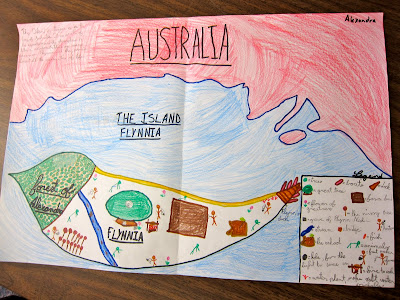
I just finished working with two groups of students on a project called "Operation Civilization" - one of my favourite challenge centres! Here, the students designed their own country, based on Earth. I made the parameters "based on Earth" so that the students would not veer off into fantasy land realities, but instead, look at concepts that are real to us on Earth: concepts of government, leadership, economics, trade, national identity, and nation building.
So, students had a great time designing and thinking about their countries...
This student placed her country near Italy and thought about government, and trade, and natural resources. Her motto was "A nation of peace"
All students made a quiz about their nation that the other students had to complete after each student went around the classroom and read about each others projects.
Many of the students created island communities.
This student created an underwater civilization...the criteria was "as long as you can justify and speak to it... and take questions from the audience" then you can do it!!!
Some students created models.
Others drew detailed maps...
Most importantly, they all LOVED sharing their ideas with each other!
Thank you my creative OPCIV students who joined me this year in designing your own country. You were all magical and wonderful to work with.
Subscribe to:
Posts (Atom)