Showing posts with label social emotional needs. Show all posts

Saturday, March 8, 2014

What should I being doing for my child?


What should I be doing for my child?

Often, I get asked this question by involved and dedicated parents.  My response has changed over the years!  15 years ago, I would have told parents to get out the math books and do enrichment math, or get ahead, or challenge kids with writing activities, reading the classics, and taking on classes or workshops.  The more, the better!  

Now, I ask:  what is your child doing outside of school?  

Because, usually the child is involved in a plethora of outside sports, enrichment classes, language classes, music classes, or art lessons.  Which, can be a great thing for the child.  

But..now I wonder....and respond:  "does your child have 'down time'? " - a phrase used quite often in our family.  Down time is our children's time to tinker, hang out, maybe play video games, or read, or even watch TV!  We have down time because the rest of the time the boys are doing homework, or skiing, or involved in some hyper intense activity.

I also ask parents:  Does your child read?  Does your child get outside and exercise?  Does your child turn off the technology, and have time away from screens?  This is because I think it is vastly important to not only have "down time" but also time to get away from technology and to interact with real people and real situations in the world.

Above all, parents need to be connected with their kids,  provide time for the family to be together, and finally, provide "space" so that children can relax and be kids.  

I am noticing that more and more parents and children are anxious.  Anxiety is running rampant throughout our highly industrialized and complex society.  This constant worry about "getting ahead" and "providing everything" for our children is not helpful to this young generation.  You and your children have everything you need, and the best gift you can give your child is the ability to relax, enjoy life, and take pleasure in the small things! 


Friday, March 29, 2013

Spring Break Reading


Always trying to find interesting books for kids and to keep abreast of what is new and exciting in the book world, I have a few good books to recommend.  I just finished reading these books over spring break...

 Nerd Camp is great if you are a gifted student or if you have a gifted child because it is about this boy who goes away to a summer gifted camp called The Summer Centre for Gifted Enrichment SCGE (I would love to be at this camp!).  The main character, Gabe, wants to impress his new soon to be step-brother, Zack, who is a 'cool kid' - not into reading or science or school.  Gabe starts to test his hypothesis  "Am I a nerd who only has nerdy adventures?" at camp.   I loved this book...it was fun and gifted kids will be able to relate to the characters.


Being adopted myself, I could absolutely relate to this book!  I had tears at the end because no matter where you come from, it is the parents who raise and love you that are "your real parents"! This book is about a Korean boy, raised by Italian parents, and his quest to find out who he is.  I loved the characters and felt the author did a great job showing the difficulty of wanting to protect your child but also support your child in their quest to find their identity!  I think all adopted children, adults, and parents who adopt should read this book.


Fun stuff...a good adventure story about a blended family being stranded on a deserted island.  This is the first in a series.  Not heavy reading, but good survival material.


I was just introduced to this mystery series, and I think it is fun because it deals with cooking, mysteries, and history.  The first book takes place in Vancouver, which is a great hook for students in this city.  I just finished the first book, "Neil Flambe and the Marco Polo Murders" and I am going to read the second, "Neil Flambe and Aztec Abduction" and third, "Neil Flambe and Crusader's Curse". 

Happy Reading!

Sunday, March 25, 2012

Ski Racing and Authentic Praise in Education

Inside the Ski Racing Mind: Don't Praise Your Children! | Ski Racing

 This is a great article on how we praise children in sports, and particularly, how we often say "good job" or "great work" and praise outcomes rather than processes.  There is a reference to Carol Dweck's research! Basically, the article talks about not praising inborn talent (you are a gifted skier), but rather praise the areas the child has control over, such as effort, attitude, responsibility, commitment, discipline, focus, emotional mastery, fitness, technique, equipment preparation.   

How does this apply to working with gifted students, and all students?  We need to provide opportunities for the inborn talent to emerge, AND provide encouragement and support for the areas the student has control over....their effort, responsibility, their focus, their preparation, and discipline.  Both work together.  (I believe the innate talent is revealed by the emotional maturity and mastery of the student, but this is a entirely different blog post!). 

Our family has fallen into the ski racing world.  Through this world, my sons have learned a great deal about hard work, disappointment, being organized, the importance of a good attitude, and how to work as a team in a very tough sport.  I am so grateful for the lessons they are learning!  The biggest lesson is disappointment.  My older son races really well, but he is not the fastest kid.  He doesn't win medals.  However, he goes to the award ceremonies after the races, and waits patiently, thinking that perhaps, this time, he will get a medal.  Afterwards, he is crestfallen.  He works so hard and there isn't an external reward for him!

So, we use this as a lesson:  we debrief, we talk about disappointment, and hard work, and we try to focus him on the good things, like being in the moment and knowing that you did your best.  It is so hard and tough, but we are building resiliency, one step at a time.  

Let's focus on building resiliency in our students and teaching them that innate abilities are important (and interesting), but that IT IS our intentions, and our effort, and our hard work, and our commitment, and our passion for what we are doing that matter much much more. Disappointment is good.  It refocuses our soul and helps us learn.  


Ski Racing and Authentic Praise in Education

Inside the Ski Racing Mind: Don't Praise Your Children! | Ski Racing

 This is a great article on how we praise children in sports, and particularly, how we often say "good job" or "great work" and praise outcomes rather than processes.  There is a reference to Carol Dweck's research! Basically, the article talks about not praising inborn talent (you are a gifted skier), but rather praise the areas the child has control over, such as effort, attitude, responsibility, commitment, discipline, focus, emotional mastery, fitness, technique, equipment preparation.   

How does this apply to working with gifted students, and all students?  We need to provide opportunities for the inborn talent to emerge, AND provide encouragement and support for the areas the student has control over....their effort, responsibility, their focus, their preparation, and discipline.  Both work together.  (I believe the innate talent is revealed by the emotional maturity and mastery of the student, but this is a entirely different blog post!). 

Our family has fallen into the ski racing world.  Through this world, my sons have learned a great deal about hard work, disappointment, being organized, the importance of a good attitude, and how to work as a team in a very tough sport.  I am so grateful for the lessons they are learning!  The biggest lesson is disappointment.  My older son races really well, but he is not the fastest kid.  He doesn't win medals.  However, he goes to the award ceremonies after the races, and waits patiently, thinking that perhaps, this time, he will get a medal.  Afterwards, he is crestfallen.  He works so hard and there isn't an external reward for him!

So, we use this as a lesson:  we debrief, we talk about disappointment, and hard work, and we try to focus him on the good things, like being in the moment and knowing that you did your best.  It is so hard and tough, but we are building resiliency, one step at a time.  

Let's focus on building resiliency in our students and teaching them that innate abilities are important (and interesting), but that IT IS our intentions, and our effort, and our hard work, and our commitment, and our passion for what we are doing that matter much much more. Disappointment is good.  It refocuses our soul and helps us learn.  


Friday, January 6, 2012

Fixed Mind Set vs. Growth Mind Set


I have just been looking at this great poster that I downloaded about "Fixed and Growth Mind Sets".  There has been a great deal of research and writing about this concept over the last few years, and here is an interesting article in the NY times magazine about the research of Carol Dweck and her book.

Lately, I have been talking about this with my sons and using the language that  we have a "growth mindset". This poster


is on my fridge.   Yesterday we were talking about challenges, persisting in the face of roadblocks, and using effort as the path towards mastery.  My one son is involved in ski racing, and he is just beginning to learn about being in a competitive sport with lots of talented athletes.  So we used this chart to talk about how to persevere when things may not be going our way.  It was great to have the visuals and the language to discuss how we can think about set backs and challenges in our lives and in our learning.   

I would like to use this as a topic of discussion with students in the challenge centre.  It would be interesting to have students talk about their own mind sets.  If we can empower students to understand how their intelligence can be developed, then we are giving them tools for life.

As well, I have Carol Dweck's book on my reading list!

Fixed Mind Set vs. Growth Mind Set


I have just been looking at this great poster that I downloaded about "Fixed and Growth Mind Sets".  There has been a great deal of research and writing about this concept over the last few years, and here is an interesting article in the NY times magazine about the research of Carol Dweck and her book.

Lately, I have been talking about this with my sons and using the language that  we have a "growth mindset". This poster


is on my fridge.   Yesterday we were talking about challenges, persisting in the face of roadblocks, and using effort as the path towards mastery.  My one son is involved in ski racing, and he is just beginning to learn about being in a competitive sport with lots of talented athletes.  So we used this chart to talk about how to persevere when things may not be going our way.  It was great to have the visuals and the language to discuss how we can think about set backs and challenges in our lives and in our learning.   

I would like to use this as a topic of discussion with students in the challenge centre.  It would be interesting to have students talk about their own mind sets.  If we can empower students to understand how their intelligence can be developed, then we are giving them tools for life.

As well, I have Carol Dweck's book on my reading list!

Wednesday, October 26, 2011

Learning for the future....

We had a great conversation the other day....the world is changing so fast, and how do we know what our children are learning will be relevant to their world and to their future?  How can we even imagine what their world will be like?  

Think back to your own education....when I was in high school in the early 1980's, we were learning to type on typewriters....in university a few years later, students still typed out their assignments.  Now, it is ipod this and ipad that and keep twittering to keep up; have a blog, get on facebook, and be connected every second of every day!!!!

So, how do multiplication tables, and cursive writing, and worksheets, and drills fit into our crazy world and how does this connect to our students and where they are going?  

How do you balance the old and the new?  What is important to you?  What do you think is important for your students? 


Learning for the future....

We had a great conversation the other day....the world is changing so fast, and how do we know what our children are learning will be relevant to their world and to their future?  How can we even imagine what their world will be like?  

Think back to your own education....when I was in high school in the early 1980's, we were learning to type on typewriters....in university a few years later, students still typed out their assignments.  Now, it is ipod this and ipad that and keep twittering to keep up; have a blog, get on facebook, and be connected every second of every day!!!!

So, how do multiplication tables, and cursive writing, and worksheets, and drills fit into our crazy world and how does this connect to our students and where they are going?  

How do you balance the old and the new?  What is important to you?  What do you think is important for your students? 


Wednesday, September 28, 2011

The Mind Up Curriculum


I have the pleasure of knowing two fantastic teachers in the Vancouver School Board who are responsible for developing, promoting, teaching, and living the MIND UP curriculum, which started in our city!!!!!!

This curriculum is important for all children, and very important for gifted students who are often intense, "in their head" learners, who often have a million things on the go.....extra-curricular activities, clubs, sports, music lessons, after school enrichment or training.......you name it; they do it!!!

If you are a teacher, this is a valuable resource and a means to get your students focused, mindful, and resilient.  As the introduction states, "MindUp is a comprehensive, classroom-tested, evidence-based curriculum framed around 15 easily implemented lessons that foster social and emotional awareness, enhance psychological well-being, and promote academic success."

I love this program, and I have used strategies from it in the challenge centre, although it is best used in a full time classroom environment, or if you work with students on a regular basis over the course of a school year (I see students for 2-4 days, so it is more challenging for me to use it regularly).

The program teaches us how the brain works, mindful awareness, goes into sharpening our senses, moves onto perspective taking, being optimistic, and finally, brings us to finding gratitude in our lives, and taking mindful action into the world.  It is beautifully pulled together, and is backed by brain research.

For teachers and parents, this is a valuable tool to use with gifted students and many ideas can be used at home as well. For example,  I teach my own children about mindful breathing and we have also used the strategies for perspective taking.

In Canada, you can order the resource from Scholastic Canada, and it is available in three levels:  Grades Pre K-2; Grades 3-5; and Grades 6-8.  There is also training for teachers (offered through the VSB), and hopefully, there will be parent workshops in the future.

The Mind Up Curriculum


I have the pleasure of knowing two fantastic teachers in the Vancouver School Board who are responsible for developing, promoting, teaching, and living the MIND UP curriculum, which started in our city!!!!!!

This curriculum is important for all children, and very important for gifted students who are often intense, "in their head" learners, who often have a million things on the go.....extra-curricular activities, clubs, sports, music lessons, after school enrichment or training.......you name it; they do it!!!

If you are a teacher, this is a valuable resource and a means to get your students focused, mindful, and resilient.  As the introduction states, "MindUp is a comprehensive, classroom-tested, evidence-based curriculum framed around 15 easily implemented lessons that foster social and emotional awareness, enhance psychological well-being, and promote academic success."

I love this program, and I have used strategies from it in the challenge centre, although it is best used in a full time classroom environment, or if you work with students on a regular basis over the course of a school year (I see students for 2-4 days, so it is more challenging for me to use it regularly).

The program teaches us how the brain works, mindful awareness, goes into sharpening our senses, moves onto perspective taking, being optimistic, and finally, brings us to finding gratitude in our lives, and taking mindful action into the world.  It is beautifully pulled together, and is backed by brain research.

For teachers and parents, this is a valuable tool to use with gifted students and many ideas can be used at home as well. For example,  I teach my own children about mindful breathing and we have also used the strategies for perspective taking.

In Canada, you can order the resource from Scholastic Canada, and it is available in three levels:  Grades Pre K-2; Grades 3-5; and Grades 6-8.  There is also training for teachers (offered through the VSB), and hopefully, there will be parent workshops in the future.

Saturday, September 10, 2011

A Back to School Read for Friday's Fiction

I am starting a weekly segment called "Friday's Fiction" whereby I will review books (on Fridays) to use in the classroom. 

I bought this book on Pender Island this summer, and I fell in love with the illustrations.


This book is about a new student who has to sit at the front of the class, and sits next to the narrator.  Marshall's "things are different than mine", and he "doesn't eat normal food" is how the narrator views the new boy.  
So, we are introduced to Marshall Armstrong, who does things a little differently!

The narrator goes on to state:
"Marshall Armstrong doesn't have a TV at home.  Her prefers the paper.  His dad says it gives him a good perspective.
Marshall Armstrong doesn't fit  in at our school.  Not one bit."

Finally, the narrator is invited to Marshall's birthday, which he doesn't really want to go to; but surprisingly, Marshall has the greatest house:  
"We can run around inside and... There is a Mexican pinata to open.  We play hide and seek all over the house.  We rebuild Mr. Armstrong's train set.  We take turns to look at the sky through a telescope, and through a microscope at the cut on Jane's arm."

The narrator has a great time, and thinks differently about Marshall.
Finally, another new student (Elizabeth Bell) arrives at the school, and the narrator says, "I tell Miss Wright that she should sit at the front with me and Marshall for the first few days, until she settles in."

Why would a child/gifted student like this book?
The illustrations are wonderful, and the humour is fantasic.  All students will like this book, especially when they get to the part about Marshall's fabulous house and his birthday party!
What's life got to do with it?
This book is great to use in the beginning of the school year to introduce new students to the classroom, and talk about how we are individuals. I would discuss the idea of being new, and how that can be very difficult.  I would use it to talk about how we each have our own individual style and ways of learning.


How would one use this book in the classroom, for discussions, extensions?
Teachers can use this as a writing prompt to write about "The first day of school" or "how are you like Marshall Armstrong..." 

I would use this book to talk about identity, friendship, and understanding for others.  For example, I would talk about how students eat different kinds of food, and that it is wonderful to explore and appreciate our culinary differences in class.  I would talk about Marshall Armstrong's home and his birthday, and how Marshall's home may be different from your own, and that is interesting and exciting. 

Personally, I bought the book for the illustrations and the humour, and because I love the look of the book.  I enjoy pouring over the illustrations and  seeing how the author builds the story around the great drawings!  David Mackintosh has wonderful talent, and I am looking forward to more of his books!

A Back to School Read for Friday's Fiction

I am starting a weekly segment called "Friday's Fiction" whereby I will review books (on Fridays) to use in the classroom. 

I bought this book on Pender Island this summer, and I fell in love with the illustrations.


This book is about a new student who has to sit at the front of the class, and sits next to the narrator.  Marshall's "things are different than mine", and he "doesn't eat normal food" is how the narrator views the new boy.  
So, we are introduced to Marshall Armstrong, who does things a little differently!

The narrator goes on to state:
"Marshall Armstrong doesn't have a TV at home.  Her prefers the paper.  His dad says it gives him a good perspective.
Marshall Armstrong doesn't fit  in at our school.  Not one bit."

Finally, the narrator is invited to Marshall's birthday, which he doesn't really want to go to; but surprisingly, Marshall has the greatest house:  
"We can run around inside and... There is a Mexican pinata to open.  We play hide and seek all over the house.  We rebuild Mr. Armstrong's train set.  We take turns to look at the sky through a telescope, and through a microscope at the cut on Jane's arm."

The narrator has a great time, and thinks differently about Marshall.
Finally, another new student (Elizabeth Bell) arrives at the school, and the narrator says, "I tell Miss Wright that she should sit at the front with me and Marshall for the first few days, until she settles in."

Why would a child/gifted student like this book?
The illustrations are wonderful, and the humour is fantasic.  All students will like this book, especially when they get to the part about Marshall's fabulous house and his birthday party!
What's life got to do with it?
This book is great to use in the beginning of the school year to introduce new students to the classroom, and talk about how we are individuals. I would discuss the idea of being new, and how that can be very difficult.  I would use it to talk about how we each have our own individual style and ways of learning.


How would one use this book in the classroom, for discussions, extensions?
Teachers can use this as a writing prompt to write about "The first day of school" or "how are you like Marshall Armstrong..." 

I would use this book to talk about identity, friendship, and understanding for others.  For example, I would talk about how students eat different kinds of food, and that it is wonderful to explore and appreciate our culinary differences in class.  I would talk about Marshall Armstrong's home and his birthday, and how Marshall's home may be different from your own, and that is interesting and exciting. 

Personally, I bought the book for the illustrations and the humour, and because I love the look of the book.  I enjoy pouring over the illustrations and  seeing how the author builds the story around the great drawings!  David Mackintosh has wonderful talent, and I am looking forward to more of his books!

Sunday, May 8, 2011

Unschooling Rules

I have been reading Unschooling Rules by Clark Aldrich.  I am very impressed.  I found out about this book by stumbling upon a wonderful and refreshing blog 
The Daily Prep created by  Aldrich's wife, Muffy Aldrich.  I love the clarity and authenticity of her blog and her insights. 


Now, back to the book; as an educator, who has been away from university for a while, I do not have the time to read extensive articles about education and the state of affairs of our gracious profession.  I have children, I have a busy life, and I have lots of commitments.  So, I loved how Aldrich's book is full of insights that are profound and clear statements about how we need to look at education.  The premise of the book is "55 ways to unlearn what we know about schools and rediscover education".  Each rule is a big idea that warrants thinking and discussion.  


Refreshing.


Aldrich begins by stating that there are seven C's of education:  curricula, content, coaching, customization, community, credit, and care.  He then goes into more detail about each.  


Here are some of the ideas that stuck with me:
  • create and use periods of reflection
  • explore, then play, then add rigor
  • customization is important
  • feed passions and embrace excellence
  • minimize the drop off
These ideas resonate with me because these are ideas I try to bring into the Challenge Centre and use in my parenting and teaching.    I will be talking about each of these ideas in further blog posts.  Today, I like:

Create and use periods of reflection:


"A critical part of the learning process is time for quiet reflection about activities - both before and after they are undertaken.  So the busier children are the less they may actually be learning." pg. 35

Aldrich states that "School Days" should have extensive down times - that is, stretches without scheduled activities and even without the context of impending homework.  

I found this very powerful.  Often, I view The Challenge Centre as a place for students just to be.  To spend time thinking, tinkering, and talking.  Almost as a break from "regular school".  This rule also brought to mind one of the pivotal parenting experiences I had with my older son.  When he was finishing  grade one, just before summer break, I told him about all the programs he was going to be doing that summer:  art camp, violin lessons, swimming lessons, Kumon Math!  We had just finished a busy year filled with school and extra tutoring and lots of enriching activities. I was in the "hyper parenting" mode of having my child involved in everything so that he would have academic success.  


My son looked at me, with tears in his eyes, and said, "Mommy, I don't want to do anything this summer.  I just want to play."  It was then that my world came crashing down and I realized how my son needed down time and reflection time. He had spent this intense school year with all these activities I had done (probably more for me than for him) and he was tired and just needed to reflect.  What did our summer look like?   Lot's of reading, building lego, playing at the park, swimming without lessons, and hanging out together.  I learned a profound lesson that summer:  periods of reflection are critical to our lives. I have taken this lesson into all of my summers with my kids and we plan for "reflection".


I hope that schools and programs and parents build reflection into their lives.  I live by it. 


Unschooling Rules

I have been reading Unschooling Rules by Clark Aldrich.  I am very impressed.  I found out about this book by stumbling upon a wonderful and refreshing blog 
The Daily Prep created by  Aldrich's wife, Muffy Aldrich.  I love the clarity and authenticity of her blog and her insights. 


Now, back to the book; as an educator, who has been away from university for a while, I do not have the time to read extensive articles about education and the state of affairs of our gracious profession.  I have children, I have a busy life, and I have lots of commitments.  So, I loved how Aldrich's book is full of insights that are profound and clear statements about how we need to look at education.  The premise of the book is "55 ways to unlearn what we know about schools and rediscover education".  Each rule is a big idea that warrants thinking and discussion.  


Refreshing.


Aldrich begins by stating that there are seven C's of education:  curricula, content, coaching, customization, community, credit, and care.  He then goes into more detail about each.  


Here are some of the ideas that stuck with me:
  • create and use periods of reflection
  • explore, then play, then add rigor
  • customization is important
  • feed passions and embrace excellence
  • minimize the drop off
These ideas resonate with me because these are ideas I try to bring into the Challenge Centre and use in my parenting and teaching.    I will be talking about each of these ideas in further blog posts.  Today, I like:

Create and use periods of reflection:


"A critical part of the learning process is time for quiet reflection about activities - both before and after they are undertaken.  So the busier children are the less they may actually be learning." pg. 35

Aldrich states that "School Days" should have extensive down times - that is, stretches without scheduled activities and even without the context of impending homework.  

I found this very powerful.  Often, I view The Challenge Centre as a place for students just to be.  To spend time thinking, tinkering, and talking.  Almost as a break from "regular school".  This rule also brought to mind one of the pivotal parenting experiences I had with my older son.  When he was finishing  grade one, just before summer break, I told him about all the programs he was going to be doing that summer:  art camp, violin lessons, swimming lessons, Kumon Math!  We had just finished a busy year filled with school and extra tutoring and lots of enriching activities. I was in the "hyper parenting" mode of having my child involved in everything so that he would have academic success.  


My son looked at me, with tears in his eyes, and said, "Mommy, I don't want to do anything this summer.  I just want to play."  It was then that my world came crashing down and I realized how my son needed down time and reflection time. He had spent this intense school year with all these activities I had done (probably more for me than for him) and he was tired and just needed to reflect.  What did our summer look like?   Lot's of reading, building lego, playing at the park, swimming without lessons, and hanging out together.  I learned a profound lesson that summer:  periods of reflection are critical to our lives. I have taken this lesson into all of my summers with my kids and we plan for "reflection".


I hope that schools and programs and parents build reflection into their lives.  I live by it. 


Tuesday, May 3, 2011

Parenting Your Gifted Child


Just found this amazing article on Parenting Your Gifted Child 
in a parent friendly question and answer format. 

I know that many teachers are concerned with gifted students who have social issues or may lack social skills or graces.  

Often, these students aren't aware of how they are perceived by others, and their quest for knowledge, for answers, and for insights, and their connections are beyond most people.  

Dr. Vidisha Patel, a therapist in Sarasota Florida and a member of the Board of Directors of SENG (Social and Emotional Needs of Gifted) answers some very interesting questions.
Here are a few samples of the questions put to Dr. Patel:

How can parents avoid using giftedness as a way to excuse unacceptable behaviour?

What are the specific challenges facing parents with regard to teaching gifted children the social graces?

What are the most crucial social skills kids need to learn?

This is a great article to print or make reference to in parent workshops, and information sessions for parents. 

Parenting Your Gifted Child


Just found this amazing article on Parenting Your Gifted Child 
in a parent friendly question and answer format. 

I know that many teachers are concerned with gifted students who have social issues or may lack social skills or graces.  

Often, these students aren't aware of how they are perceived by others, and their quest for knowledge, for answers, and for insights, and their connections are beyond most people.  

Dr. Vidisha Patel, a therapist in Sarasota Florida and a member of the Board of Directors of SENG (Social and Emotional Needs of Gifted) answers some very interesting questions.
Here are a few samples of the questions put to Dr. Patel:

How can parents avoid using giftedness as a way to excuse unacceptable behaviour?

What are the specific challenges facing parents with regard to teaching gifted children the social graces?

What are the most crucial social skills kids need to learn?

This is a great article to print or make reference to in parent workshops, and information sessions for parents. 

Wednesday, April 27, 2011

Social and Emotional Needs of Gifted Students

 I was meant to organize a workshop on the Social and Emotional Needs of Gifted Students.  However, the term ran away from me, and I didn't get my resources together in time to create a workshop.  I am adding this to my huge list of things to do, and hopefully, in the fall, I will deliver on the workshop! 

The social/emotional needs of gifted students is an area that I am very interested and passionate about. Sensitivity, perfectionism, and anxiety are often huge areas of concern for the gifted child and the parents of these children. 

So, looking at the social and emotional needs, in a general sense, here are some great places to start:

1.  A synopsis of Tracy L. Cross's book "The Social and Emotional Lives of Gifted Kids"  and Practical Advice for Guiding Gifted Children

2.  Here is an interesting blog post 10 Social and Emotional Needs of the Gifted 
at Byrdseed Gifted.

3. The SENG website (Social Emotional Needs of Gifted) has many articles that can be downloaded. 

I will be compiling more resources and information on this topic in the near future (let's say...summer....when I have some time to focus on the larger tasks).

Let me know if you have any great resources on this topic.  I would be very interested in sharing.
 

Social and Emotional Needs of Gifted Students

 I was meant to organize a workshop on the Social and Emotional Needs of Gifted Students.  However, the term ran away from me, and I didn't get my resources together in time to create a workshop.  I am adding this to my huge list of things to do, and hopefully, in the fall, I will deliver on the workshop! 

The social/emotional needs of gifted students is an area that I am very interested and passionate about. Sensitivity, perfectionism, and anxiety are often huge areas of concern for the gifted child and the parents of these children. 

So, looking at the social and emotional needs, in a general sense, here are some great places to start:

1.  A synopsis of Tracy L. Cross's book "The Social and Emotional Lives of Gifted Kids"  and Practical Advice for Guiding Gifted Children

2.  Here is an interesting blog post 10 Social and Emotional Needs of the Gifted 
at Byrdseed Gifted.

3. The SENG website (Social Emotional Needs of Gifted) has many articles that can be downloaded. 

I will be compiling more resources and information on this topic in the near future (let's say...summer....when I have some time to focus on the larger tasks).

Let me know if you have any great resources on this topic.  I would be very interested in sharing.
 

Tuesday, November 30, 2010

Images of Greatness


 I just worked with an incredible group of students!!!!  All of them were exceptional candidates for this program, and they worked so hard to complete their projects in 3.5 days.  Here is a sample of some of the projects.  A few of the students did power point presentations, so their work is not represented in this post.  The above image is of a Tesla coil.

The goal of the challenge centre program was to bring a group of students together, to learn about eminent people and to see if there are comparisons they can make to their own life and journey.  Students chose a person they were interested in learning more about, and they researched and created products of learning that demonstrated learning!
 This student created a biography on Dr. Seuss and it rhymed!!!


 A great idea was for the students to create alphabet books about their chosen person...

 Students had a checklist of requirements:  a time line; a business card, a presentation, and biography were all requirements of this project. 


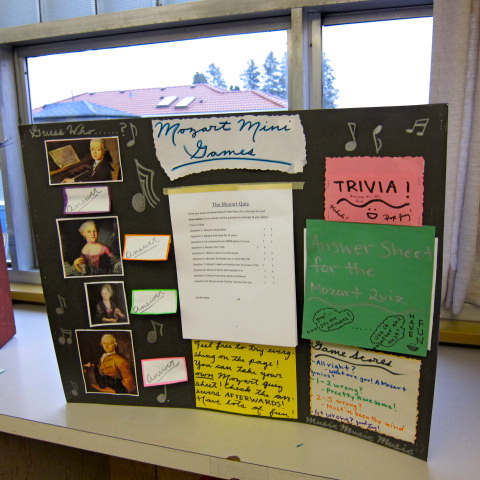
 Students could present their learning on a back-board or in poster format...


 Students were also given the choice to make a learning box of items that represented the person.  Here is Helen Keller's alphabet book, and various items.


 I liked these Jane Austen inspired puppets!


 This time line was created to represent the Nile River...what a great way to do a time line!!!


 The students chose the following eminent people to study:  Amelia Earhart, Hetshepsut, Claude Monet, Dr. Seuss, Nikola Tesla, Jane Austen, Helen Keller,  Mozart, Leonardo DaVinci, John Lennon, Walt Disney, and Wayne Gretzky.
Thank you, students!  You are all incredible learners and you did such an amazing job...I hope to work with all of you again!   Keep learning and doing your best!

And thank you teachers for sending such lovely students my way!  I am always inspired by their ideas and enthusiasm for learning....