Monday, April 25, 2011
Happy Easter!

Happy Easter!
Marble Ramp Challenge


I gave the students a wonderful challenge on day 3 of the program: build a marble ramp to demonstrate the concept of gravity. The marble must start at the top and travel to the bottom of your "marble ramp".
Materials: cardboard boxes of various sizes, toilet paper rolls, egg cartons, strawberry plastic containers, tape, straws, and other various recyclable materials.
Students were given the choice to work alone, or with a partner.
The students had to demonstrate their marble ramp at the end, and explain how they designed it.
For safety reasons, I would help them cut out holes, etc., using an exacto-knife. These were grade 3's after all!
The students worked from 9:00 am until 11:30; straight through, with a 15 minute recess break. All were engaged, and focused.
I loved leaving it wide open, allowing them to problem solve and create, and be true designers, creators, and problem solvers.
I think this is real learning: building and creating, and figuring it out in a hands-on manner. The students loved it!
Marble Ramp Challenge
I gave the students a wonderful challenge on day 3 of the program: build a marble ramp to demonstrate the concept of gravity. The marble must start at the top and travel to the bottom of your "marble ramp".
Materials: cardboard boxes of various sizes, toilet paper rolls, egg cartons, strawberry plastic containers, tape, straws, and other various recyclable materials.
Students were given the choice to work alone, or with a partner.
The students had to demonstrate their marble ramp at the end, and explain how they designed it.
For safety reasons, I would help them cut out holes, etc., using an exacto-knife. These were grade 3's after all!
The students worked from 9:00 am until 11:30; straight through, with a 15 minute recess break. All were engaged, and focused.
I loved leaving it wide open, allowing them to problem solve and create, and be true designers, creators, and problem solvers.
I think this is real learning: building and creating, and figuring it out in a hands-on manner. The students loved it!
Wednesday, April 13, 2011
Gizmos and Gadgets Challenge Centre
I have just worked with a group for the first two days of a four day program. The program is about learning science concepts and building contraptions and learning about the inventions and the invention process.
 Here's a sample of what we did:
We began by brainstorming: What is an inventor?
If you could invent anything in the world, what would it be?
Then we discussed these ideas, and I gave a little lecture on inventors (3 minutes). We shared ideas, and I got some great ones- I was looking for ideas such as curiosity, creativity, perseverance, great problem solvers and so forth.
We discussed qualities of inventors, and I showed this great post:
The 50 Best Inventions of 2010
Then, we talked about types of inventions, and I had the students sort various inventions, into categories of their own. We came up with ideas like "inventions that save lives", "inventions that make lives better", and "electronics", "inventions for fun". I was attempting to get the students to think about inventions as solving problems in the real world.
Then, we talked about four ways to invent:
1. Make improvements: the car was an improvement on the carriage; What other inventions can you tell me about that are improvements on things we know?
2. Make combinations: the iphone is a combination of a cellular phone, camera, and an ipod. What other combinations of items do you know about that made a new invention?
3. Make breakthroughs: a completely new idea. Do you have any new invention ideas that are completely original? Can you think of any examples? (Here, the students gave ideas such as "the time machine". This is a hard one, and they really had to think!)
4. Use mistakes: Teflon was created as a mistake.
This brought up great discussion; however, too much talk and not enough action is hard for grade three's.
So, we ended off the day with a simple "hands on activity" called 45 Minutes to 4 that had them working in groups and creating simple items:


The students were given 45 minutes to create 4 usable products out of pieces of paper.
The materials were:
4 pieces of construction paper
masking tape
scissors for cutting
a pencil
a ruler
(pencil, ruler, scissors are materials to use; not part of the creations)
The students are given the choice to construct 4 out of the 5 objects:
1. One object that can hold water (we test at the end)
2. One object that will keep rain off one member's head
3. A device that will magnify a voice
4. A stand-up name card to identify your learning group (name your group!)
5. A device that shows the exact measurement of one member's waist.
Well, it is always fantastic to see the original ideas, the team work, the problem solving, and the elaborate contraptions made out of paper and tape. This is something that can be easily done in a classroom setting. During this activity, I look for:
I am not sure where I got this activity, but it can easily be set up. The glory of doing activities like this is that students love the "hands on nature" of the process. They get to use their thinking skills, and most importantly, there is no right answer...all process driven, sharing of ideas, and then moving forward. A bit like inventing!
We began by brainstorming: What is an inventor?
If you could invent anything in the world, what would it be?
Then we discussed these ideas, and I gave a little lecture on inventors (3 minutes). We shared ideas, and I got some great ones- I was looking for ideas such as curiosity, creativity, perseverance, great problem solvers and so forth.
We discussed qualities of inventors, and I showed this great post:
The 50 Best Inventions of 2010
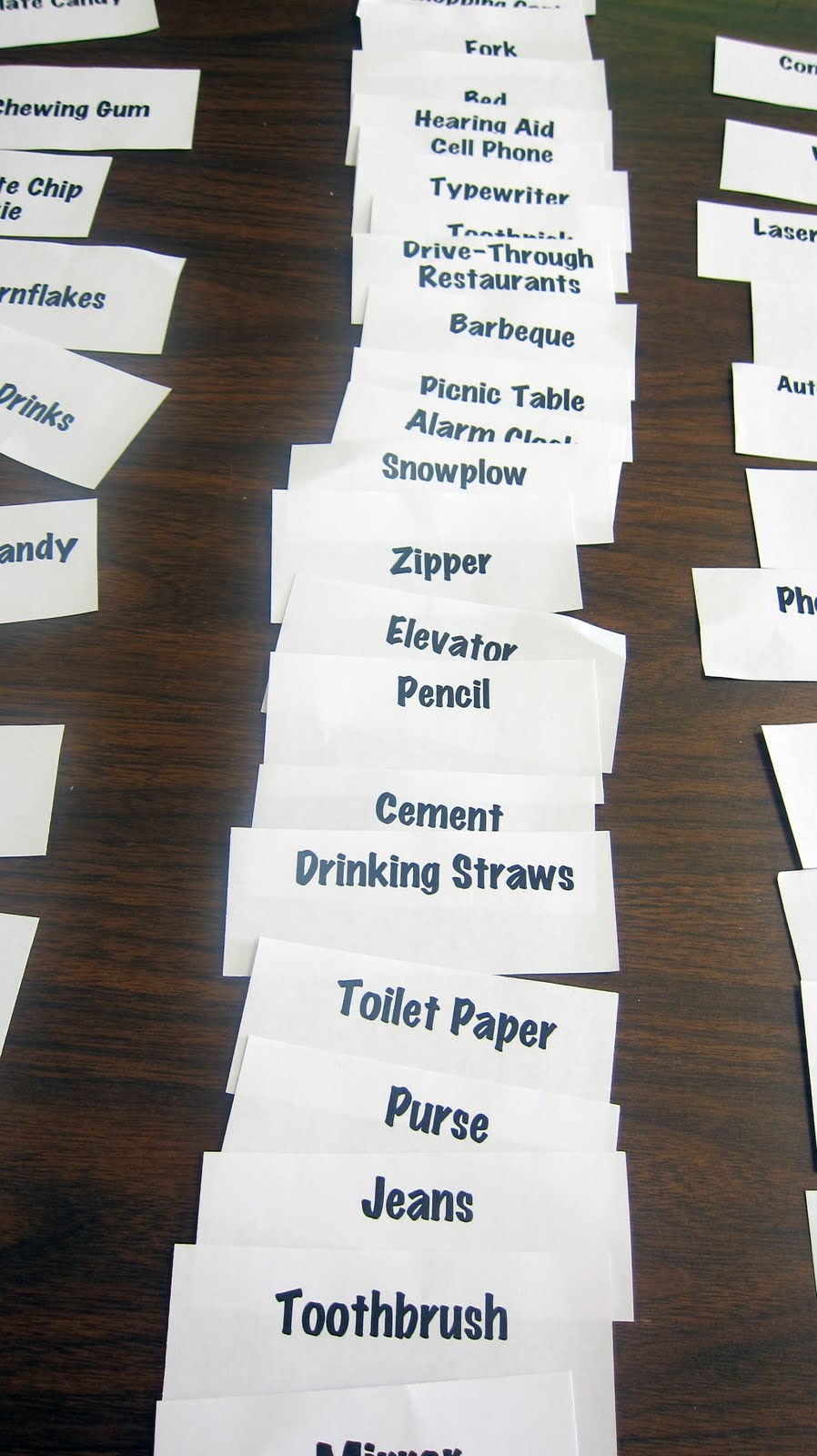
Then, we talked about types of inventions, and I had the students sort various inventions, into categories of their own. We came up with ideas like "inventions that save lives", "inventions that make lives better", and "electronics", "inventions for fun". I was attempting to get the students to think about inventions as solving problems in the real world.
Then, we talked about four ways to invent:
1. Make improvements: the car was an improvement on the carriage; What other inventions can you tell me about that are improvements on things we know?
2. Make combinations: the iphone is a combination of a cellular phone, camera, and an ipod. What other combinations of items do you know about that made a new invention?
3. Make breakthroughs: a completely new idea. Do you have any new invention ideas that are completely original? Can you think of any examples? (Here, the students gave ideas such as "the time machine". This is a hard one, and they really had to think!)
4. Use mistakes: Teflon was created as a mistake.
This brought up great discussion; however, too much talk and not enough action is hard for grade three's.
So, we ended off the day with a simple "hands on activity" called 45 Minutes to 4 that had them working in groups and creating simple items:


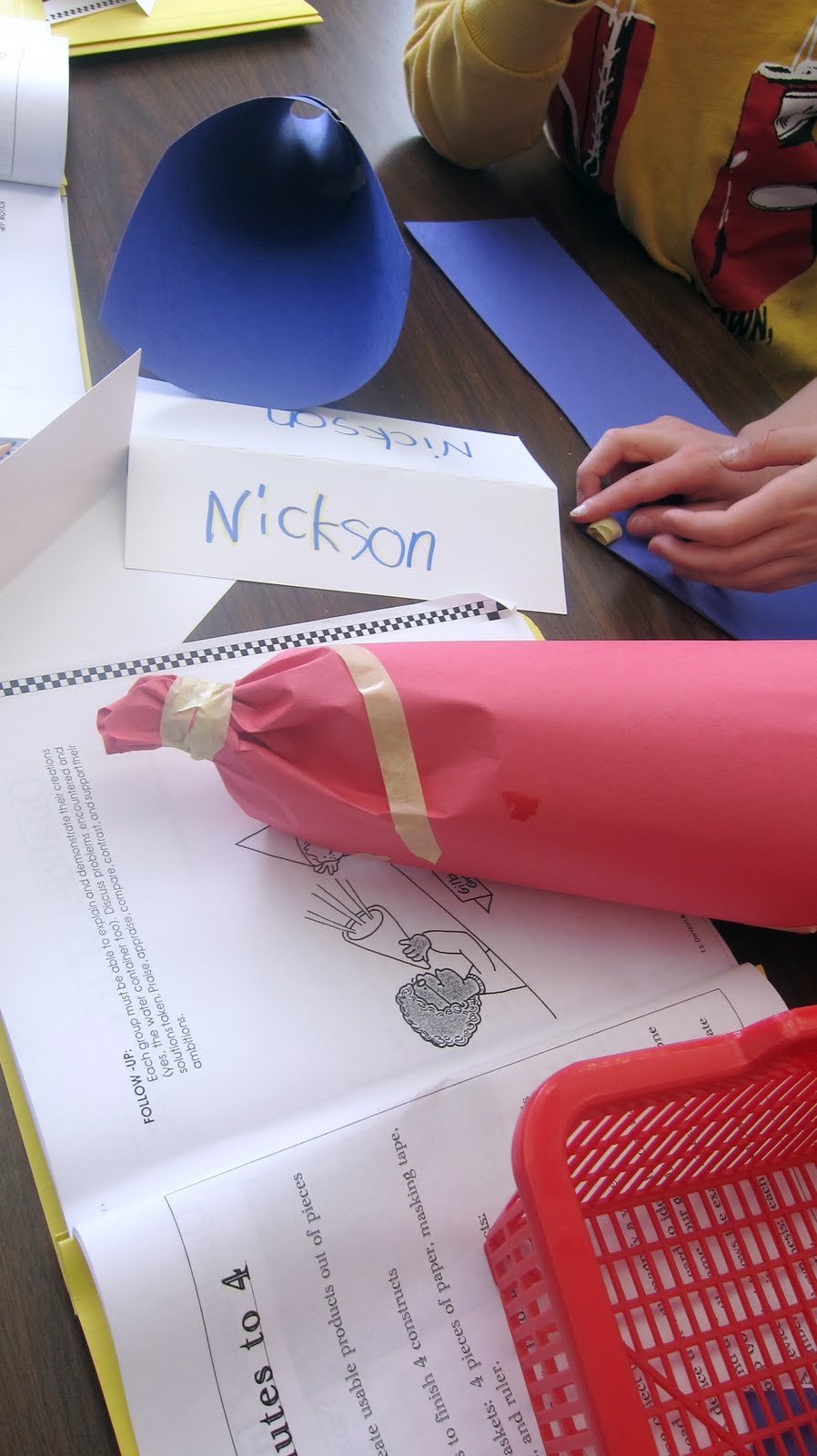
The students were given 45 minutes to create 4 usable products out of pieces of paper.
The materials were:
4 pieces of construction paper
masking tape
scissors for cutting
a pencil
a ruler
(pencil, ruler, scissors are materials to use; not part of the creations)
The students are given the choice to construct 4 out of the 5 objects:
1. One object that can hold water (we test at the end)
2. One object that will keep rain off one member's head
3. A device that will magnify a voice
4. A stand-up name card to identify your learning group (name your group!)
5. A device that shows the exact measurement of one member's waist.
Well, it is always fantastic to see the original ideas, the team work, the problem solving, and the elaborate contraptions made out of paper and tape. This is something that can be easily done in a classroom setting. During this activity, I look for:
- how the team works together
- how they problem solve around using paper to create objects
- what objects they choose (all groups chose number 1, and they all wanted to test their creations to see which team created the best water holder!)
I am not sure where I got this activity, but it can easily be set up. The glory of doing activities like this is that students love the "hands on nature" of the process. They get to use their thinking skills, and most importantly, there is no right answer...all process driven, sharing of ideas, and then moving forward. A bit like inventing!
Gizmos and Gadgets Challenge Centre
I have just worked with a group for the first two days of a four day program. The program is about learning science concepts and building contraptions and learning about the inventions and the invention process.
Here's a sample of what we did:
We began by brainstorming: What is an inventor?
If you could invent anything in the world, what would it be?
Then we discussed these ideas, and I gave a little lecture on inventors (3 minutes). We shared ideas, and I got some great ones- I was looking for ideas such as curiosity, creativity, perseverance, great problem solvers and so forth.
We discussed qualities of inventors, and I showed this great post:
The 50 Best Inventions of 2010
Then, we talked about types of inventions, and I had the students sort various inventions, into categories of their own. We came up with ideas like "inventions that save lives", "inventions that make lives better", and "electronics", "inventions for fun". I was attempting to get the students to think about inventions as solving problems in the real world.
Then, we talked about four ways to invent:
1. Make improvements: the car was an improvement on the carriage; What other inventions can you tell me about that are improvements on things we know?
2. Make combinations: the iphone is a combination of a cellular phone, camera, and an ipod. What other combinations of items do you know about that made a new invention?
3. Make breakthroughs: a completely new idea. Do you have any new invention ideas that are completely original? Can you think of any examples? (Here, the students gave ideas such as "the time machine". This is a hard one, and they really had to think!)
4. Use mistakes: Teflon was created as a mistake.
This brought up great discussion; however, too much talk and not enough action is hard for grade three's.
So, we ended off the day with a simple "hands on activity" called 45 Minutes to 4 that had them working in groups and creating simple items:
The students were given 45 minutes to create 4 usable products out of pieces of paper.
The materials were:
4 pieces of construction paper
masking tape
scissors for cutting
a pencil
a ruler
(pencil, ruler, scissors are materials to use; not part of the creations)
The students are given the choice to construct 4 out of the 5 objects:
1. One object that can hold water (we test at the end)
2. One object that will keep rain off one member's head
3. A device that will magnify a voice
4. A stand-up name card to identify your learning group (name your group!)
5. A device that shows the exact measurement of one member's waist.
Well, it is always fantastic to see the original ideas, the team work, the problem solving, and the elaborate contraptions made out of paper and tape. This is something that can be easily done in a classroom setting. During this activity, I look for:
I am not sure where I got this activity, but it can easily be set up. The glory of doing activities like this is that students love the "hands on nature" of the process. They get to use their thinking skills, and most importantly, there is no right answer...all process driven, sharing of ideas, and then moving forward. A bit like inventing!
We began by brainstorming: What is an inventor?
If you could invent anything in the world, what would it be?
Then we discussed these ideas, and I gave a little lecture on inventors (3 minutes). We shared ideas, and I got some great ones- I was looking for ideas such as curiosity, creativity, perseverance, great problem solvers and so forth.
We discussed qualities of inventors, and I showed this great post:
The 50 Best Inventions of 2010
Then, we talked about types of inventions, and I had the students sort various inventions, into categories of their own. We came up with ideas like "inventions that save lives", "inventions that make lives better", and "electronics", "inventions for fun". I was attempting to get the students to think about inventions as solving problems in the real world.
Then, we talked about four ways to invent:
1. Make improvements: the car was an improvement on the carriage; What other inventions can you tell me about that are improvements on things we know?
2. Make combinations: the iphone is a combination of a cellular phone, camera, and an ipod. What other combinations of items do you know about that made a new invention?
3. Make breakthroughs: a completely new idea. Do you have any new invention ideas that are completely original? Can you think of any examples? (Here, the students gave ideas such as "the time machine". This is a hard one, and they really had to think!)
4. Use mistakes: Teflon was created as a mistake.
This brought up great discussion; however, too much talk and not enough action is hard for grade three's.
So, we ended off the day with a simple "hands on activity" called 45 Minutes to 4 that had them working in groups and creating simple items:
The students were given 45 minutes to create 4 usable products out of pieces of paper.
The materials were:
4 pieces of construction paper
masking tape
scissors for cutting
a pencil
a ruler
(pencil, ruler, scissors are materials to use; not part of the creations)
The students are given the choice to construct 4 out of the 5 objects:
1. One object that can hold water (we test at the end)
2. One object that will keep rain off one member's head
3. A device that will magnify a voice
4. A stand-up name card to identify your learning group (name your group!)
5. A device that shows the exact measurement of one member's waist.
Well, it is always fantastic to see the original ideas, the team work, the problem solving, and the elaborate contraptions made out of paper and tape. This is something that can be easily done in a classroom setting. During this activity, I look for:
- how the team works together
- how they problem solve around using paper to create objects
- what objects they choose (all groups chose number 1, and they all wanted to test their creations to see which team created the best water holder!)
I am not sure where I got this activity, but it can easily be set up. The glory of doing activities like this is that students love the "hands on nature" of the process. They get to use their thinking skills, and most importantly, there is no right answer...all process driven, sharing of ideas, and then moving forward. A bit like inventing!
Sunday, April 10, 2011
A good resource for concepts such as motion, forces, gravity
I am excited to be working with students over the next few weeks (4 sessions) on concepts such as motion, gravity, balance, and spin. We will be looking at Newton's three laws of motion, inventions, and I will introduce them to Rube Goldberg. For most of the unit, I have referred to this great resource called "Gizmos and Gadgets" written by Jill Frankel Hauser. It is a great resource for teachers and for parents alike. I will be posting during the week, showcasing some of things we create together.
Here's a link where to buy it, but I am sure you can find it locally as well. If you are a teacher and want to borrow this resource from me, please let me know (we lend out all our resources at the Challenge Centre) by emailing me!
| Gizmos and Gadgets |
| |||

Subscribe to:
Posts (Atom)